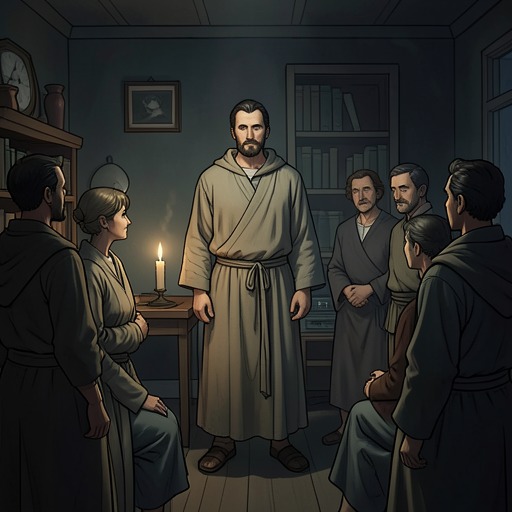
1786 Confinement of the Åkian Leaders
The EmigrantsThe 1786 Confinement of the Åkian Leaders was the state’s coercive response to a dissenting religious community: after church warnings and civil proceedings failed to make them recant, Åke Svensson and seven other leaders were sent to Danvik’s asylum. Four died there within two years. The episode supplies the remembered history of persecution behind the later Åkian revival, and makes the question of who may claim religious authority inseparable from the bodily cost of defying it.
Background and Conflict
Åkianism began in the neighboring parish of Elmeboda around 1780 and spread to Ljuder. Its adherents sought to imitate the early Christian church and return to the apostles’ way of life. They separated from the established church, rejected temporal and spiritual authorities within their community, and treated distinctions of property and social rank as contrary to God’s word. Their communal practice extended to worship and Holy Communion: no object was regarded as belonging to an individual.
The movement challenged a religious order built around instruction and enforced unity. The 1686 church law prescribed evangelical-Lutheran formation, while the royal Resolution and Order of January 12, 1726, was intended to protect parish life from teachings deemed dangerous and to preserve Christian unity. Against this background, the Åkians’ separate services and refusal to return to the established church were not treated as private differences of belief; they became a matter for both ecclesiastical discipline and civil authority.
About forty people in Elmeboda and Ljuder had joined the sect. Many belonged to Åke Svensson’s extended family, spread across the two parishes. In Ljuder, the group’s center was Kärragärde, the home of Åke’s brother-in-law, Andreas Månsson. The authorities’ action therefore fell on a community rooted in kinship and shared household life, not on isolated individuals alone.
Proceedings and Confinement
The bishopric of Växiö summoned the Åkians for questioning and issued strong warnings. They remained inflexible and answered the church dignitaries with words described as unpropitious. The church pronounced its ban, but the dissenters retained their convictions. Civil proceedings followed: brought before Konga County Court in Ingelstad, Åke and his followers were admonished to obey the law and the regulations of the established church. They refused to recant or return to what the court regarded as the only true church.
The case was then reviewed by the Göta Crown Court. In the name of church peace and civil security, the court declared the sect members to have lost their sound minds and concluded that they should be confined in an asylum, ostensibly for both public order and the dissenters’ welfare. Its ruling turned religious nonconformity into a diagnosis and made confinement the remedy prescribed for it.
The eight people named in the order were handed over to the sheriff and transported to Danvik’s asylum in Stockholm in 1786. The court’s language promised that they would receive such care as their condition warranted. The subsequent outcome gives that official assurance a grim resonance: Åke Svensson, Andreas Månsson, and two other detainees died within two years. Åke was thirty-five at the time of his death.
Aftermath and Historical Return
The other dissenters were gradually released and returned to their homes, officially described as cured. They lived quietly and harmoniously, and for years it seemed that the movement’s fire had been extinguished. But Åkianism reappeared in Ljuder in the 1840s. The earlier confinement thus becomes more than a closed episode in parish history: it is the precedent behind a later conflict, showing how an attempt to suppress a faith could silence its adherents for a time without erasing the beliefs that bound them together.
Faith, Authority, and Suffering
The episode places competing claims to authority in direct opposition. The Åkians’ communal life and independent worship embodied their conviction that religious practice did not depend on the established church; the courts answered with ecclesiastical bans, civil admonition, and confinement. By describing the legal decision as both a defense of public peace and an act for the dissenters’ welfare, the account exposes how institutional power could present coercion as care.
That history also informs the novel’s recurring tension between providence and human responsibility. Elsewhere, Nils Jakob’s Son accepts his crippling accident as preordained by God, and Kristina interprets the chain of events in her life as divinely directed. Yet the memory of the Åkian leaders’ deaths complicates any easy assurance that suffering is simply part of a benevolent plan: the court’s declared purpose and the human consequences diverge. The story’s later religious scenes, including Danjel’s renewed practice and his appeal to Scripture during the storm at sea, inherit this unresolved question of how faith persists under pressure—and how human authorities can mistake dissent for illness.